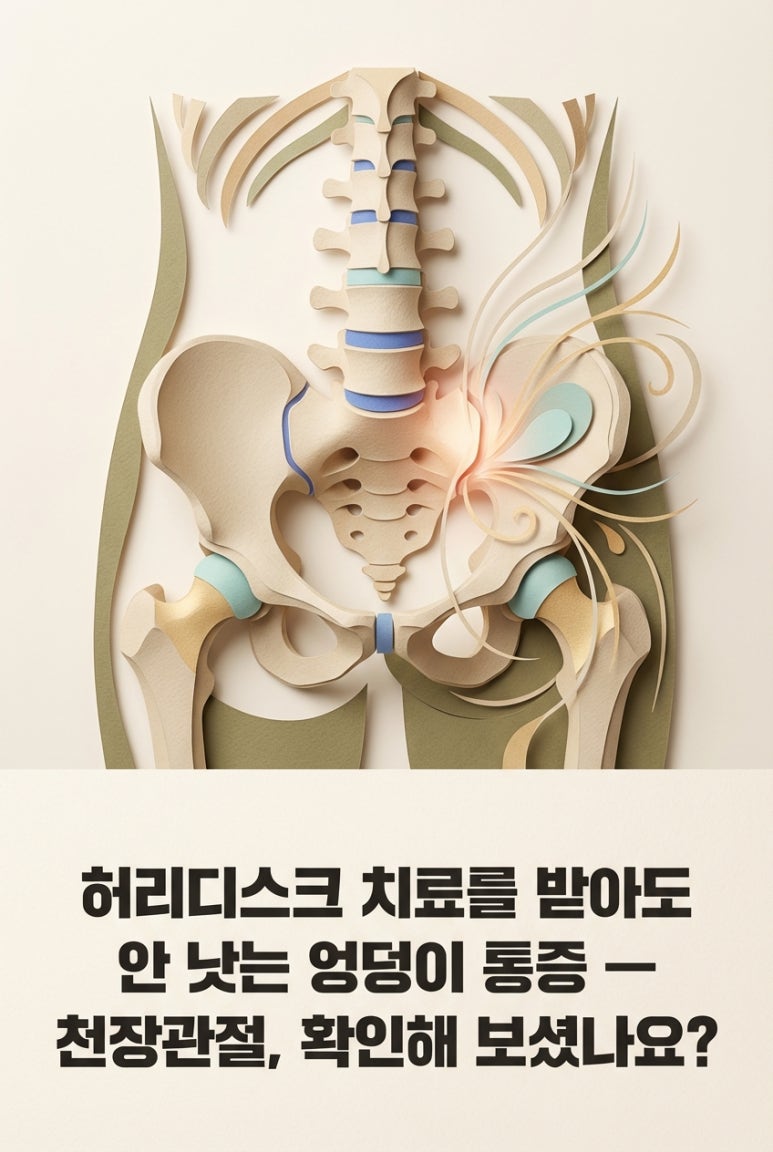
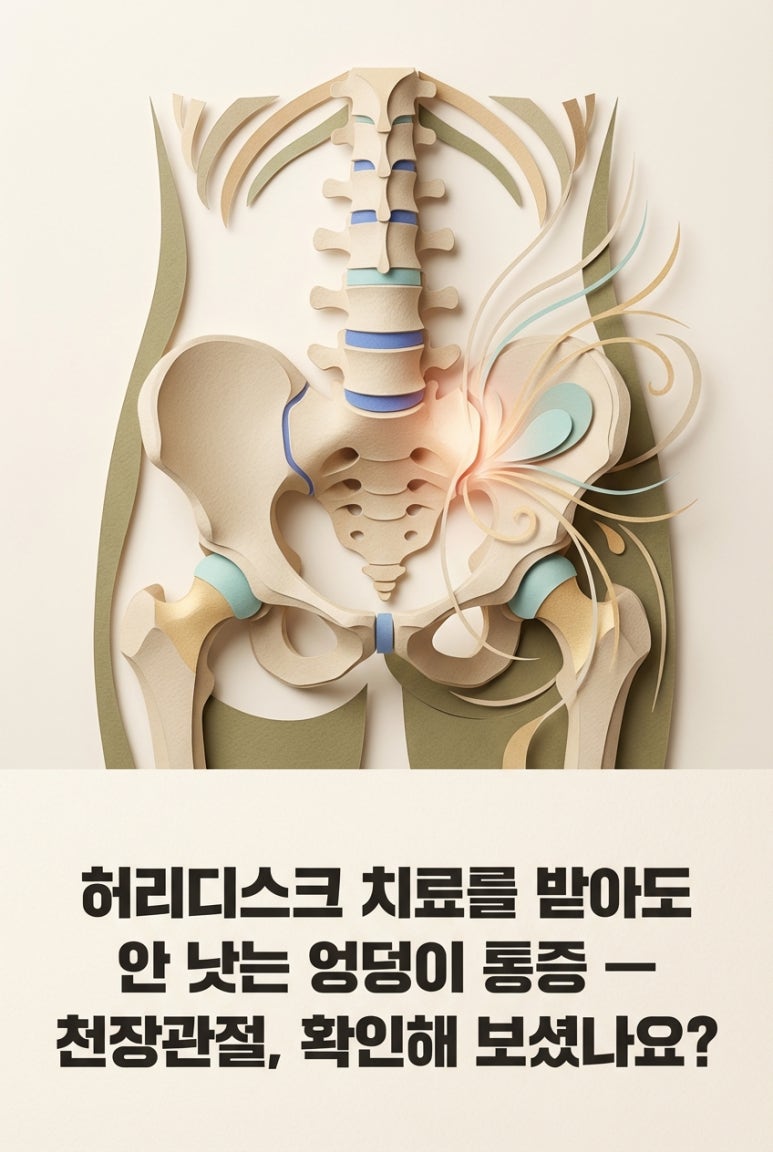
Buttock Pain That Won't Go Away Even After Lumbar Disc Treatment — Have You Checked Your Sacroiliac Joint?

 🧾 Answer First | Core Conclusion
I've received disc treatment multiple times, but the deep buttock pain persists.
I've had MRI scans, received injections, and attended physical therapy consistently, but nothing has changed.
Does this situation sound like you right now?
15-30% of low back pain patients have pain originating from the sacroiliac joint, not a lumbar disc[1][2].
The sacroiliac joint is located at the back of the pelvis, deep in the buttock area.
Because it's often not well-visualized on MRI, it's frequently misdiagnosed as a disc problem.
When the diagnosis is wrong, the treatment is also wrong.
Try the 3 methods we're introducing today to check for yourself.
 ✅ Action | Immediate Steps
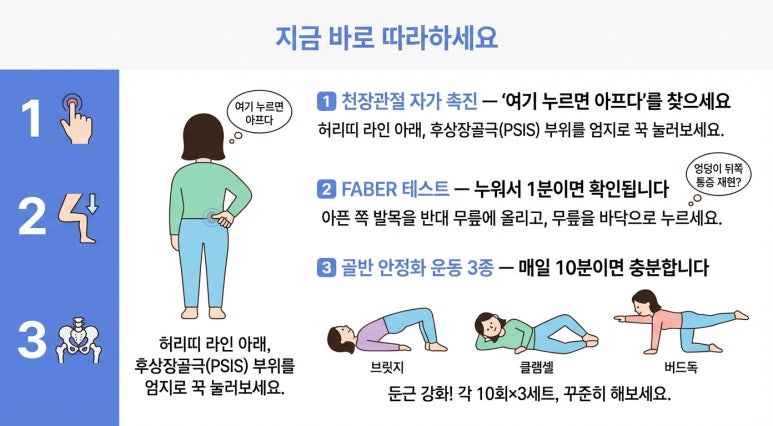
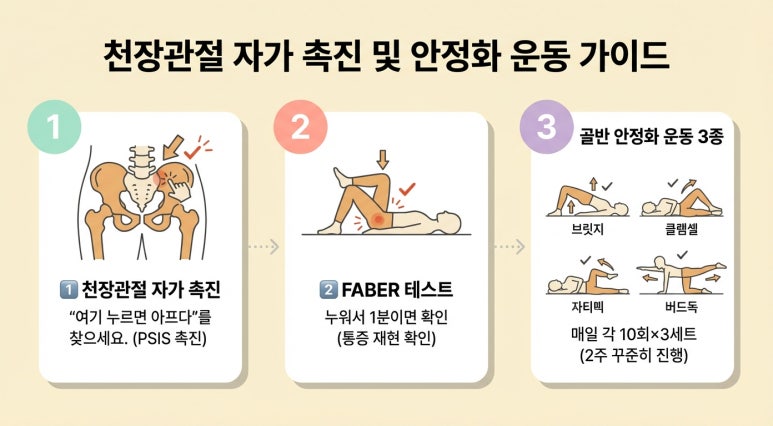
1️⃣ Sacroiliac Joint Self-Palpation — Find the spot that hurts when pressed
Moving your hand down from the waistline toward the buttocks, you'll feel a bony protrusion on both sides.
This is called the posterior superior iliac spine (PSIS).
Press firmly on this area with your thumb.
If only one side is distinctly painful, you should suspect a sacroiliac joint problem.
2️⃣ FABER Test — Takes 1 minute to check while lying down
Lie flat on your back and place the ankle of the painful side on top of the opposite knee, creating a "4" shape.
From this position, slowly press the painful-side knee downward toward the floor.
If you experience familiar buttock pain during this, the sacroiliac joint is likely the cause.
3️⃣ Pelvic Stabilization Exercises 3 Types — 10 minutes daily is sufficient
The sacroiliac joint becomes unstable when the gluteal muscles (buttock muscles) weaken.
Try the following 3 exercises daily: 10 repetitions × 3 sets each.
Bridge: Lie on your back, set up your knees, and lift your buttocks
Clamshell: Lie on your side and spread your knees (like a clam shell)
Bird Dog: In a quadruped position, extend the opposite arm and leg
If there's no change after consistently doing this for 2 weeks or more, there may be a problem with the joint itself, requiring professional detailed diagnosis.
 🚨 Warning | Red Flags That Must Be Checked
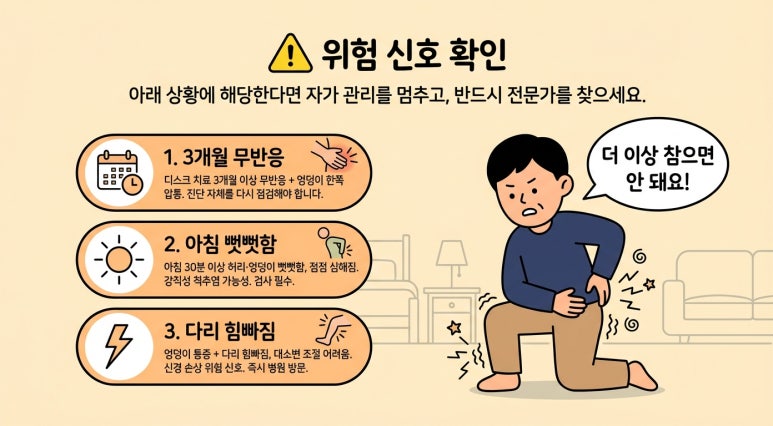
If any of the following applies to you, stop self-care and seek a professional immediately.
✔ No response to disc treatment for 3+ months + one-sided buttock tenderness
If treatment isn't helping, it's a signal that the diagnosis itself needs to be rechecked.
Especially if pressing on only one buttock side causes pain, strongly suspect sacroiliac joint dysfunction.
✔ Morning stiffness in the lower back and buttocks lasting 30+ minutes, progressively worsening
Stiffness that eases with movement is common.
However, if it persists for over 30 minutes and worsens over weeks, there may be an autoimmune disease like ankylosing spondylitis.
Blood tests and detailed imaging are absolutely necessary.
✔ Buttock pain accompanied by leg weakness or difficulty controlling bowel/bladder function
This is a warning sign of nerve damage.
If these symptoms appear, you should go to the hospital as soon as possible.
 🧠 The Why | Anatomical Explanation
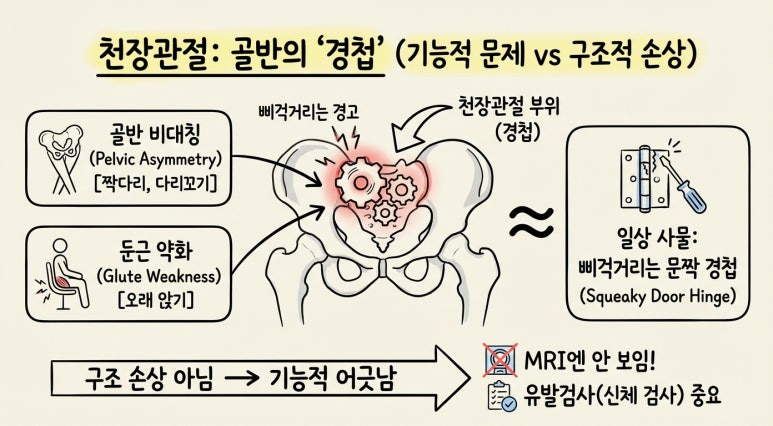
The sacroiliac joint is the pelvis's "hinge."
It connects the upper spine (sacrum) to the lower pelvic bone (ilium). If this hinge is squeaking but you keep replacing the door (disc), of course it won't improve.
Sacroiliac joint problems arise from three main causes.
Pelvic asymmetry is most common.
Habits like leaning on one leg or crossing legs one way consistently cause unequal weight distribution on one sacroiliac joint.
When repeated for several months, the ligaments around the joint become stretched and unstable.
Gluteal muscle weakness is another major cause.
Sitting for 8+ hours daily gradually weakens buttock muscles.
When muscles stabilizing the sacroiliac joint lose strength, the joint moves excessively and becomes inflamed.
Compensation patterns after disc surgery or procedures cannot be overlooked.
After disc treatment, the body changes movement patterns to protect the lower back, and that burden often shifts to the sacroiliac joint.
Why doesn't it show up on MRI?
Sacroiliac joint pain is not about structural breakdown but functional misalignment.
While MRI shows disc herniation or bone deformation well, it struggles to detect functional problems like subtle joint locking or instability.
That's why provocation testing (physical examination) is much more important.
📊 Proof | Cases and Evidence
According to international research, sacroiliac joint pain accounts for 15-30% of chronic low back pain cases[1][2].
A significant portion of these were initially diagnosed with disc problems and began treatment accordingly.
The key to diagnosis is provocation testing.
When combining tests like FABER, Gaenslen, and compression tests, 3 or more positive results increase diagnostic sensitivity for sacroiliac joint pain to 94%[3].
I encountered a male patient in his 40s in my clinic.
After 6 months of disc treatment, his left buttock pain hadn't improved at all.
When I performed sacroiliac joint provocation testing, 4 out of 5 tests were positive.
After 4 weeks of chuna therapy combined with herbal acupuncture, his pain reduced by 70%.
When diagnosis is correct, treatment response is rapid.
 🔚 Closing | Summary and Encouragement
If your buttocks continue to hurt despite diligent disc treatment, consider suspecting the sacroiliac joint.
First check yourself using the self-palpation method and FABER test we've introduced, and begin pelvic stabilization exercises.
When the diagnosis changes, treatment results change.
The longer pain has persisted, the more crucial it is to identify the accurate cause—that's the first step to recovery.
If it's difficult to judge on your own, please feel free to inquire about a consultation that can examine both your constitution and pelvic condition.
✍️ Supervised by Director Choi Jang-hyuk, Dongjejdang Korean Medicine Clinic
❓ FAQ
Q. Can sacroiliac joint pain be diagnosed with MRI?
Mostly not.
Because sacroiliac joint pain is a functional problem of the joint, it's difficult to detect with MRI, which visualizes structural abnormalities.
Combining 3 or more provocation tests (FABER, Gaenslen, compression tests, etc.) is the most accurate diagnostic method.
This is also why a normal MRI doesn't mean you're fine.
Q. How is sacroiliac joint pain different from sciatica?
Both cause similar buttock pain, but the distribution range differs.
Sciatica travels from the buttock down the back of the leg to the toes.
Sacroiliac joint pain concentrates at the boundary between buttocks and lower back, and may extend to the back of the thigh but typically doesn't extend below the knee.
Q. Is acupuncture or chuna therapy effective for sacroiliac joint pain?
Yes, it is effective.
The Korean Chuna Manual Medicine Society's clinical practice guidelines recommend chuna therapy for sacroiliac joint dysfunction at recommendation level B[4].
The approach combines acupuncture and herbal acupuncture to reduce inflammation around the joint, while chuna therapy corrects joint alignment.
📚 References
[Western Medicine (WM)]
[1] Laslett M. (2008). "Evidence-based diagnosis and treatment of the painful sacroiliac joint." J Man Manip Ther 16(3):142-152
[2] Cohen SP. (2005). "Sacroiliac joint pain: a comprehensive review." Anesth Analg 101(5):1440-1453
[3] Dreyfuss P et al. (2004). "The value of medical history and physical examination in diagnosing sacroiliac joint pain." Spine 21(22):2594-2602
[Korean Medicine (KM)]
[4] Korean Chuna Manual Medicine Association (2020). "Low Back Pain Chuna Clinical Practice Guidelines"
[5] Korean Association of Oriental Medicine (2022). "Low Back Pain Korean Medicine Clinical Practice Guidelines (CPG)"
Pain
Buttock Pain That Won't Go Away Even After Lumbar Disc Treatment — Have You Checked Your Sacroiliac Joint?
View Program