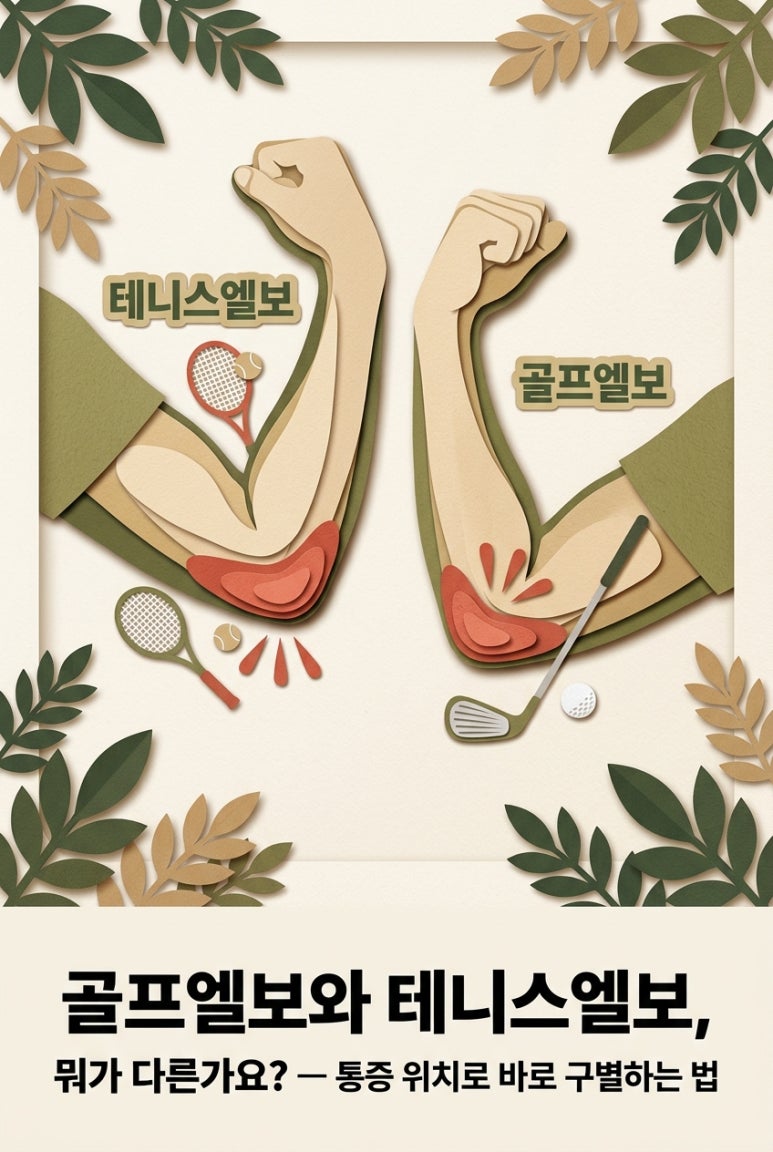
Golf Elbow vs Tennis Elbow, What's the Difference? — How to Distinguish by Pain Location
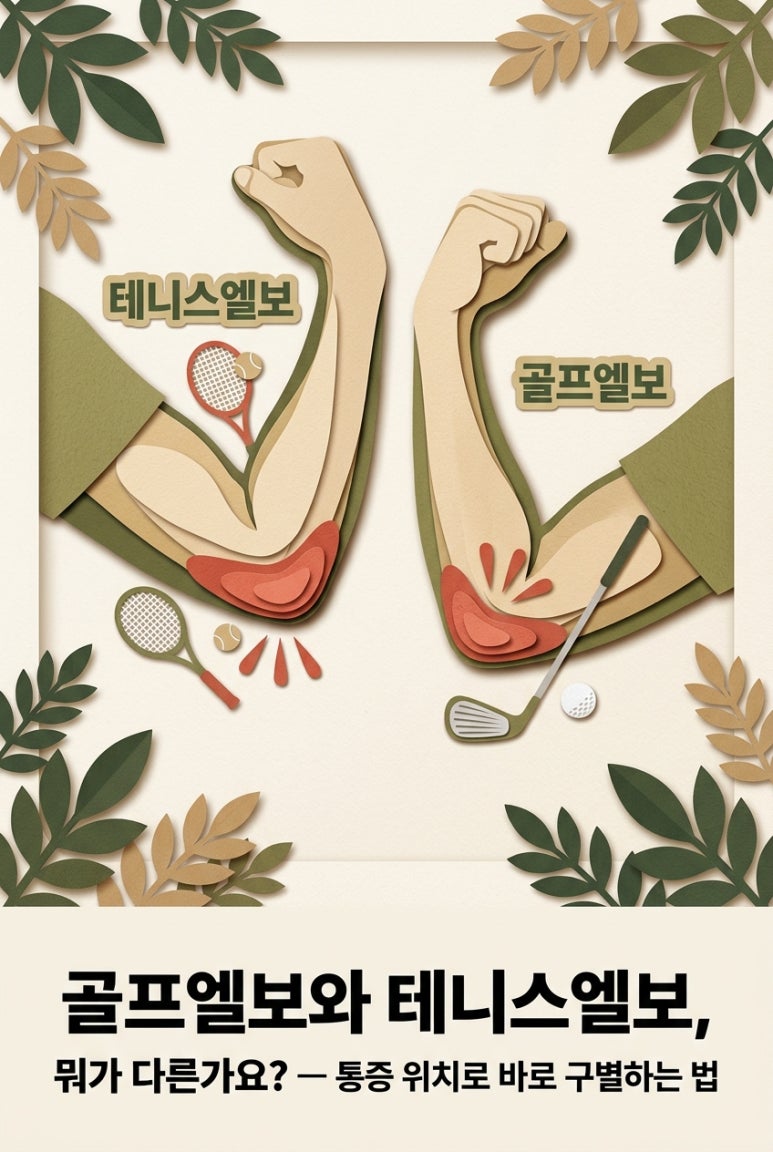 🧾 Answer First | Key Conclusion
Your elbow is throbbing, and you're confused about exactly where it hurts, right?
If the outer side hurts, it's tennis elbow; if the inner side hurts, it's golf elbow.
Not only the names are different—the affected muscles, aggravating movements, and treatment focus are all completely different.
Understanding this difference ensures you don't waste time stretching or treating the wrong area.
Try the self-diagnosis method and management tips below, one by one.
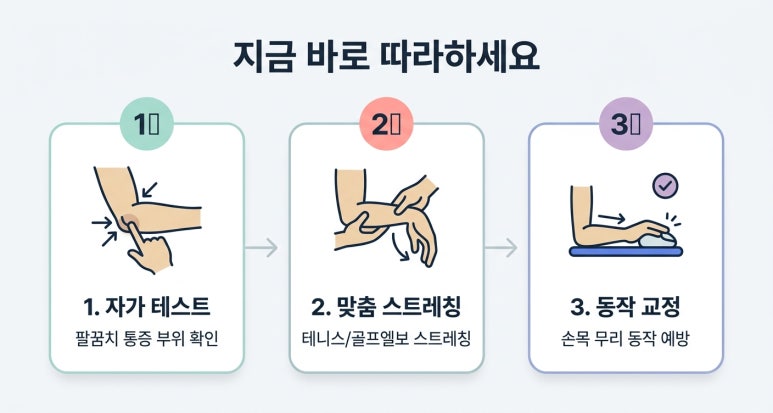 ✅ Action | Immediate Implementation
1️⃣ Self-Test for Pain Location — You can distinguish it in 30 seconds
Straighten your elbow and face the back of your hand upward.
With your other hand, press down on the back of your hand while resisting.
If it hurts near the outer bone of the elbow, you have tennis elbow.
Now, with your palm facing upward, try pressing your palm downward.
If it hurts near the inner bone, you have golf elbow.
If both hurt, you may have both conditions simultaneously.
2️⃣ Stretch only the affected muscle
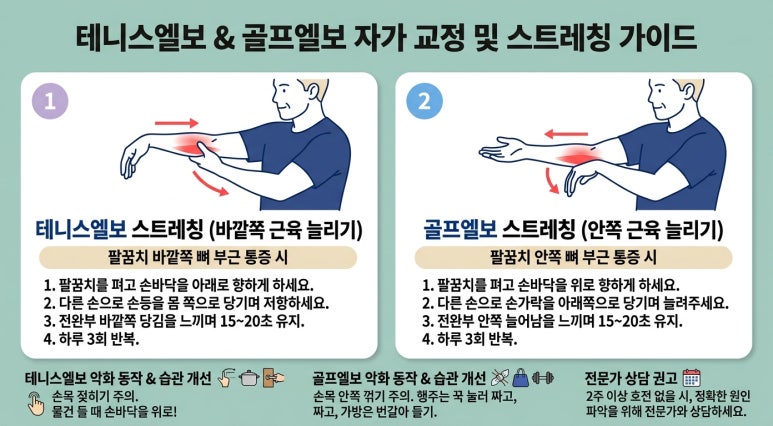
For tennis elbow (outer side): Extend your arm forward, and with your palm facing down, use your other hand to pull the back of your hand toward your body.
You should feel a stretch on the outer side of your forearm.
For golf elbow (inner side): Extend your arm forward, and with your palm facing up, use your other hand to pull your fingers downward.
The key is feeling an elongation on the inner side of your forearm.
Do this 3 times a day, holding each stretch for 15-20 seconds.
3️⃣ Identify the movements causing pain and change them
Tennis elbow worsens with wrist extension movements.
Typical examples include mouse clicking, lifting a frying pan, and turning a doorknob.
The habit of lifting objects with your palm facing upward reduces the strain.
Golf elbow gets worse with inward wrist bending movements.
Typical examples include wringing out a cloth, lifting a heavy bag, and dumbbell curls.
Instead of twisting a cloth, press it firmly to wring it out, and alternate carrying a bag between hands.
If there's no improvement after 2 weeks of self-correction, working with a professional to identify the causative movement is the fastest path forward.
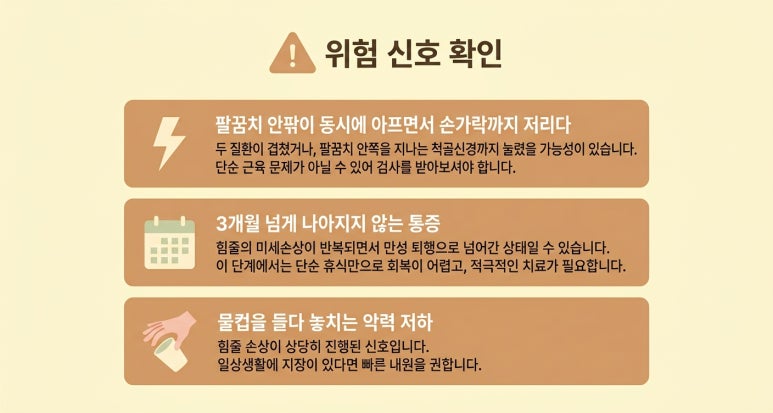 🚨 Warning | Warning Signs You Must Check
✔ Both inner and outer sides of the elbow hurt simultaneously, and your fingers are tingling
You may have both conditions overlapping, or the ulnar nerve passing through the inner elbow may be compressed.
It may not be a simple muscle problem, so you need to get it examined.
✔ Pain that doesn't improve for over 3 months
The condition may have progressed to chronic degeneration due to repeated micro-damage to the tendon.
At this stage, simple rest alone won't allow recovery, and active treatment is necessary[1].
✔ Weakened grip strength causing you to drop a water cup
This is a sign that tendon damage has progressed significantly.
If it's affecting your daily life, I recommend seeking prompt medical attention.
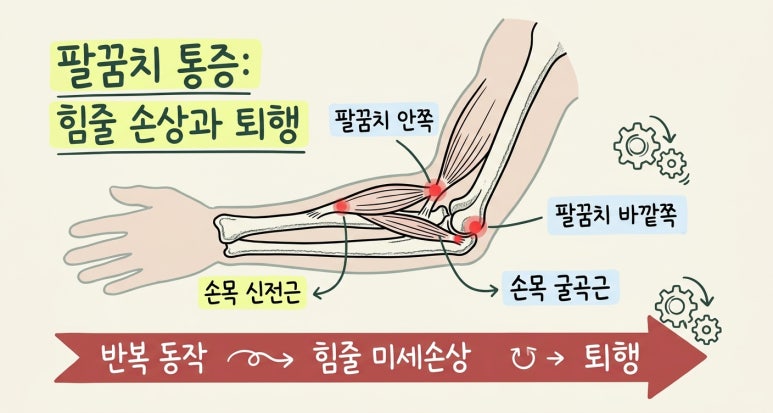 🧠 The Why | Anatomical Explanation
The wrist extensor muscles attach to the outer elbow, while the wrist flexor muscles attach to the inner side.
The muscles used when gripping and turning a doorknob are on the outer side, while those used when squeezing a cloth hard are on the inner side.
Because the painful side differs, the problematic movements are completely different too.
The attachment points of these tendons to the bone have poor blood supply, so healing is slow once injured.
When the same movement is repeated, microscopic tears accumulate, and beyond the inflammatory stage, degenerative changes become established.
Initially, it starts as tendon inflammation (tendinitis), but when it becomes chronic, the collagen structure of the tendon itself changes, progressing to tendinosis[1].
That's why anti-inflammatory medication alone doesn't provide a fundamental solution.
When repeated injury is applied to areas where qi and blood circulation is stagnant, blood stasis and phlegm accumulate, settling as pain.
Acupuncture and herbal acupuncture focus on improving local blood flow and restoring circulation around the damaged tendon[3].
 📊 Proof | Cases and Evidence
Tennis elbow and golf elbow are more common than you think.
According to research, 1-3% of the general population experience tennis elbow, and approximately 0.4-1% experience golf elbow[5].
The incidence is particularly high in people aged 40-50 and those in occupations requiring repetitive movements.
Evidence is accumulating on the effectiveness of acupuncture treatment.
According to clinical guidelines from the Korean Acupuncture and Moxibustion Society, acupuncture is effective for pain reduction and functional recovery in lateral epicondylitis[3].
When combined with herbal acupuncture, the local anti-inflammatory effect is enhanced, potentially reducing recovery time[4].
I once saw a 40-year-old male patient who developed inner elbow pain from playing golf, but he mistakenly thought he had tennis elbow and was only stretching the outer side.
After confirming the exact pain location and shifting treatment focus to the inner muscles, he was able to swing a golf club again in just 4 weeks.
🔚 Closing | Summary and Encouragement
Elbow pain changes the cause and treatment method completely based on a single location difference.
Outer side means tennis elbow, inner side means golf elbow—knowing just this prevents wasting time in the wrong place.
Start by confirming with the self-test I've provided today, then begin with the appropriate stretching.
If your pain has persisted a long time or it's difficult to self-diagnose, feel free to reach out.
Accurate differentiation is the first step to treatment.
✍️ Reviewed by Choi Jang-hyeok, Director of Dongjjedang Korean Medicine Clinic
❓ FAQ
Q. Can tennis elbow and golf elbow occur at the same time?
Yes, they can occur simultaneously.
When both the inner and outer muscles of the elbow are overused, both conditions appear together.
Especially if you do various exercises at the gym or have a job that heavily uses your hands, you should check both sides.
Q. Can you get tennis elbow without playing tennis?
Most tennis elbow patients have nothing to do with tennis.
It's much more common in office workers who use a mouse for long periods, housewives who frequently lift frying pans, and workers who use tools—anyone who repeatedly extends their wrist[5].
Q. How long does treatment usually take?
When treatment begins promptly, most patients notice significant improvement within 4-8 weeks.
However, chronic cases left untreated for over 6 months may require consistent management for 12 weeks or more.
📚 References
[Western Medicine (WM)]
[1] Coombes BK et al. (2015). "Management of Lateral Elbow Tendinopathy." JOSPT, 45(11):938-949.
[2] Bisset L et al. (2006). "A systematic review and meta-analysis of clinical trials on physical interventions for lateral epicondylalgia." Br J Sports Med, 40(4):321-326.
[5] Shiri R et al. (2006). "Prevalence and determinants of lateral and medial epicondylitis." Am J Epidemiol, 164(11):1065-1074.
[Korean Medicine (KM)]
[3] Korean Society of Acupuncture and Moxibustion (2020). "Clinical Practice Guidelines for Acupuncture Treatment of Lateral Epicondylitis of the Elbow"
[4] National Institute of Korean Medicine Evidence-Based Medicine Research Institute NIKOM (2021). "Guidelines for Korean Medicine Treatment of Musculoskeletal Disorders"
Pain
Golf Elbow vs Tennis Elbow, What's the Difference? — How to Distinguish by Pain Location
View Program